Monday, 29 September 2014

Universal Credit : list of roll-out dates

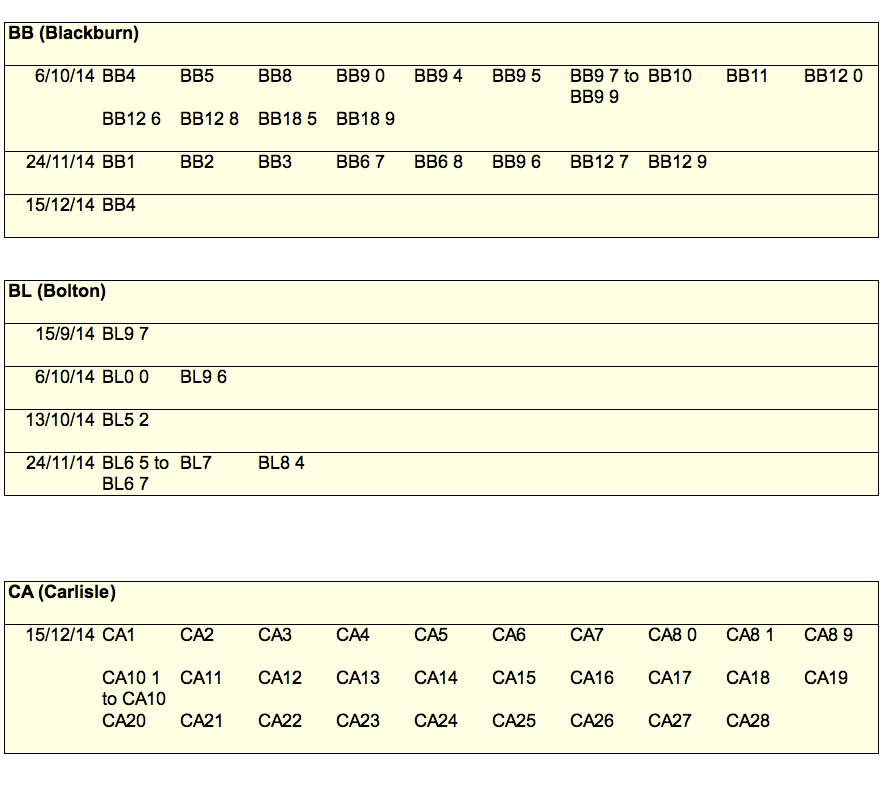
Universal Credit is rolling out a bit further this autumn. The current expansion seems to be filling in the gaps in the previous roll-outs in the northwest, and so mainly affects the big cities and towns. The postcode areas covered are therefore:

  • BB (Blackburn)
  • BL (Bolton)
  • CA (Carlisle)
  • CH (Chester)
  • CW (Crewe)
  • FY (Blackpool)
  • L (Liverpool)
  • LA (Lancaster)
  • M (Manchester)
  • OL (Oldham)
  • PR (Preston)
  • SK (Stockport)
  • WA (Warrington)
  • WN (Wigan)
Note that, at the moment, claims are only being accepted from single people and couples without children who would otherwise be claiming Jobseeker's Allowance - those unable to work will still be claiming Employment and Support Allowance, and carers will still be claiming Income Support. 

The list of which postcode areas are affected and when is provided by a DWP memo: 


The memo (and the underlying legislation) group the data by dates, so it is quite hard to see clearly how things develop in any one city or town. However, you don't need to worry about this, as I've re-arranged the data for you here.

Note that 'BB9 7' means (for example) any postcode in the format BB9 7xx, such as BB9 7AA.
If the postcode you are interested in doesn't feature here, the likelihood is that it has already been included (for example, L20 postcodes already operate Universal Credit, as the local authority involved is Sefton, not Liverpool.


Thursday, 18 September 2014

The latest threat to the Bedroom Tax?

The bedroom tax has been a frequent visitor to this blog; unsurprisingly, given the impact it has had on many benefit claimants. In my last post I looked at the government's own report on it, which found, amongst other things, that only 41% of claimants had paid the full shortfall, and that only 4.5% of tenants have actually downsized as a result of the shortfall.

However there are signs that the days of the bedroom tax, as we currently know it, are numbered. The most recent development comes in the form of a private member's bill that has been brought to Parliament. The bill's sponsor is Liberal Democrat MP Andrew George: at its second reading on 5th September 2014 MPs voted 306 to 231 in favour, and it has now awaiting scrutiny by the Public Bill Committee.

(If you want to see who voted in favour of the bill, and who didn't, check out http://www.theyworkforyou.com/debate/?id=2014-09-05a.603.0)

What is the bill intended to do?

(If you want to check out the details of the bill yourself, you can find it here: 

Let's be clear: the bill is not designed to end the bedroom tax (the 'housing benefit size criteria restrictions' to give it its official name).  However it is intended to address some of the most problematic issues.

Remember that the main effect of the bedroom tax is to reduce the maximum Housing Benefit available by 14% if a claimant has one 'too many' bedrooms, or by 25% if they have more than one. For more details see my website: http://www.benefitsowl.info/bedroom%20tax.html.

The bill addresses situations where the claimant, their partner, or a close relative is disabled. Under the current rules many people in this situation will be expected to share a room: couples, for example, are normally only entitled to one room, and some children will be expected to share. At the moment, therefore, people in this situation will have to chose between sharing where it is not appropriate, and having a 14% reduction in their maximum Housing Benefit.

If the bill were accepted there would be no reduction for a claimant in this situation, provided the disabled person was getting any component or any rate of Personal Independence Payment or Disability Living Allowance, and provided that the local authority was satisfied that it was reasonable for the disabled person to need a separate room.

Note that, in the scenario described above, a claimant would still be subject to reduction in their maximum Housing Benefit if there were additional bedrooms not needed to accommodate the disabled person. For example, if a family is currently treated as having two spare bedrooms, even though a disabled person is actually using one of them, there would still be a reduction, although it would now be 14% rather than 25%.

However, there is another provision in the bill that specifies that there should be no reduction at all, irrespective of how many bedrooms there are, if the home has been adapted to meet a disability need of the claimant, their partner, or a close relative, provided the cost of the adaptation exceeds a certain amount (the last proviso presumably existing to prevent a person making minimal changes to a property, that could easily be replicated elsewhere, in order to benefit from the rule).

The bill also addresses another very common scenario: what if there is no alternative accommodation available? Currently, if a claimant is 'under-occupying', and is willing to move to a smaller home, they are still subject to the bedroom tax even if they can find nowhere smaller to move to.

If the bill were accepted, no reduction would be made if the claimant's landlord and the local authority are not able to make a 'reasonable offer of alternative accommodation'.

Finally, the bill does something that will not affect individual claimants, but may assist tenants in the future. It proposes a review of the availability affordable and 'intermediate' housing, to assess: the extent of the need; what progress has been made to meet the need; and the availability of resources to meet the need. It also empowers the government to contribute to any solution. I doubt that this proposal will find its way into any final bill, but would be happy to be proved wrong: it would be nice to have policy that was evidence-based rather than inspired by dogma or political expediency. 

How does the bill compare to repealing the bedroom tax legislation?

For people who need an extra bedroom because of disability, and for people who would downsize if they could, the bill would be great news if it became law. However the bill does not help people who maintain that they need an extra room for other reasons (including disabled people who use the 'spare' room to store disability-related items). It also does not directly help people who are affected by the bedroom tax now, but need to stay in the same property because their children are getting older and so will need additional bedrooms soon, although it is possible that claimants in that position might be able to argue that alternative accommodation is not 'reasonable'. 

The bill also does not resolve the thorny question of what constitutes a bedroom in this context. The legislation that created the bedroom tax (the Housing Benefit (Amendment) Regulations 2012) does not define what a bedroom is, which has caused problems for claimants and for tribunals alike. In a previous post I noted a tribunal judge who used overcrowding regulations as a guide, but as this was a 1st Tier tribunal his findings do not set a precedent. If the bill became law this confusion would still exist.

On the other hand, the bill may satisfy those MPs who are unhappy about the affects of the bedroom tax on disabled constituents and those for whom alternative accommodation is not available, but nonetheless sympathise with the government's stated aim of increasing availability of homes for larger families.

If Labour win an outright majority at the next general election, they have undertaken to abolish the bedroom tax. The most recent statement I have from the Liberal Democrats is a commitment to reform the legislation: these proposals look very similar to the contents of the bill. And the Conservative party want to keep the bedroom tax (or, as they call it, the spare room subsidy) unchanged (for details of all these see my last post).


When I have more news about the bill, I'll let you know.

Friday, 25 July 2014

Shock news: Bedroom Tax isn't working(!)


I'm signed up with gov.uk to receive alerts of any press releases relating to social security matters: when they publish reports they are normally keen to let people know straight away. Oddly enough, though, they made no mention of a report they published on 15th July. The report's name is 'Evaluation of Removal of the Spare Room Subsidy: Interim report'. The 'Spare room subsidy' is, of course, what other people call the 'Bedroom Tax'.


The report is not an opinion document: it just gathers facts and presents them. The facts, though, are damning. It's not surprising that the government wasn't very happy about it.

(Remember, first, that what the bedroom tax does is this: in effect, it reduces the amount that counts as rent for Housing Benefit purposes by 14% if you have a 'spare' bedroom, or by 25% if you have two or more 'spare' bedrooms. If you want more details, check out my information on it at http://www.benefitsowl.info/bedroom%20tax.html.)

The report found that five months into the scheme, only 41% of tenants had paid the full shortfall: 39% had paid some, and 20% had paid nothing at all towards the bedroom tax.

For those who did manage to pay some or all of the increase, how did they manage this?
57% of claimants reported cutting back on housing essentials;
26% said that they had had to borrow money (mostly from family and friends, but also using credit cards and payday loans);
10% had used savings;
9% had been given money from family members;
Let's just stop there for a moment, and note, firstly, that you're in trouble if you've got no family members with spare cash, and, secondly, that those with savings will soon not have any.

Moving on again, what about taking the government's suggested route, downsizing to a suitable property. Unfortunately, the report records that only 4.5% of affected tenants have done this. But maybe this is just because people are reluctant to move? Well, no. It turns out that in local authority areas where only a few people are affected by the bedroom tax, many more (up to 16%) are able to downsize.  In other words, as the report puts it, 'this suggests that landlords with the highest proportion of affected tenants will have more difficulties in meeting the demand for downsizing'.

Furthermore, it is reported that although 19% of affected tenants had registered for downsizing, social landlords said that 'they had not yet been able to accommodate most of those who wanted to move to a smaller home'.

Unsurprisingly (at least to me) only 1.4% had moved to the private rental sector; where the discrepancy between the rent charged by the landlord and that met by Housing Benefit tends to be even higher. Don't forget, for example, that single adults under 35 can only get enough Housing Benefit to cover living in a room in a shared house.

Apart from there being nowhere to move to (as we've now established), why didn't people want to move? Many of the reasons are easy to imagine, but here's one that hadn't occurred to me (nor, I imagine, to the government): 'knowing that they would soon cease to be affected by the [bedroom tax] - for instance because a child would turn ten or 16 and would require their own room'. Yes. It makes lots of sense to move to a smaller property when in a year's time you'll be entitled to the home you've just left...

The report also looked at of Discretionary Housing Payments (DHPs), the extra housing benefit available for claimants with additional needs, who ask for it, and whose requests are granted by their local authorities. A key concern raised was that some claimants were refused because disability benefits they were getting  (i.e. Disability Living Allowance, Personal Independence Payment, etc) were treated as extra income that reduced their need for help. A further concern was that more than half (56%) of the claimants surveyed who had not applied for a DHP were unaware of them.

Finally, what about the main declared purpose of the bedroom tax (freeing up properties for large families who needed them)? 41% of social landlords surveyed said that they were having difficulty filling their larger properties. Landlords and local authorities also reported that waiting times for smaller properties had increased: don't forget that many of the people on these waiting lists will be there precisely because they are trying to do what the government wants them to do, downsize, and therefore will be forced to pay the bedroom tax for longer.


What do the main political parties want to do about the bedroom tax?

The Conservatives want to keep it, obviously, although even some of their number are expressing concerns. Somewhat startlingly (to me, anyway), Norman Tebbit has come out against it. The Huffington Post, for example, reports his comments: 'I worry about what Labour chooses to call the bedroom tax. Because so often what is a spare room is in fact a vital part of the looking after an elderly person. It enables their relatives to come, it enables carers to be there...I think we introduced that rather without thinking it through very well, and I think that's costing us.'

Labour want to scrap the tax: in fact they have an online petition about it. It's only fair to point out, though, that the previous labour government brought in the first bedroom tax, by limiting Housing Benefit to claimants renting in the private sector according to how many bedrooms they needed (amongst other factors). It was called the 'local housing allowance', was brought in in 2008, and is still in force. Furthermore, Hansard clearly indicates that it was the Labour government's intention to extend something similar to the social rented sector.

The Liberal Democrats have recently stated that they are committed to reform the bedroom tax. They say that they plans 'will see those already in the social rented sector only lose their benefit if they are offered a suitable smaller home and turn it down' and 'would also permanently exempt disabled adults'.  This isn't in line with their previous statements. The Huffington Post eloquently illustrates six opportunities when Nick Clegg could have opposed the bedroom tax but, instead, defended it. The Lib Dems don't exactly have an perfect record of keeping pre-election promises. 

Take your pick...


Monday, 5 May 2014

Universal Credit expands in the north-west

On 29th April the government announced that 'the expansion of the full Universal Credit benefit to the rest of the north west of England will start in June': 
https://www.gov.uk/government/news/universal-credit-first-year-of-welfare-transformation-and-north-west-next-steps

But what does that really mean? and who will it affect?

(For detailed information about what Universal Credit is and how it works, check out http://www.benefitsowl.info/universal%20credit.html.)

What is the situation now?

At the moment, in the north-west of England, Universal Credit only affects people who live in the following local authority areas: Wigan, Warrington, Oldham, and Tameside. These are known as 'pathfinder areas'. 

However, even in these areas, only a fairly small subset of potential claimants need to worry about Universal Credit. Universal Credit is currently only available to single claimants who are between 18 and 60½, are not working, are looking for work, and are not getting any other benefits or tax credits when they make their claim. 


What is happening from June?

From June this year Universal Credit will expand to cover claimants live in the areas covered by:


  • Bolton Borough Council
  • Bury Borough Council
  • Cheshire East Council
  • Cheshire West and Chester Council
  • Knowsley Borough Council
  • Preston City Council
  • Salford City Council
  • Sefton Borough Council
  • South Ribble Borough Council
  • St Helens Borough Council
  • Trafford Borough Council
  • Wirral Borough Council

(You might note that Manchester and Liverpool are missing from this list.)


These new areas will only be applying Universal Credit to the same group of claimants as in the earlier pathfinder areas, i.e. single claimants who are between 18 and 60½, are not working, are looking for work, and are not getting any other benefits or tax credits when they make their claim. In effect, therefore, the roll out will initially only have an impact on single jobseekers who are not getting any other benefits at the moment.

For people living in the existing pathfinder areas - Wigan, Warrington, Oldham, and Tameside - the net will gradually be expanded to include some couples making new claims, according to the government's press release.

To get an up-to-date list of areas that are included check out https://www.gov.uk/universal-credit/eligibility

When you say 'from June'...

Well...

There are two important phrases in the government's press release: 

  • 'from June more jobcentres across the north west of England will gradually come online each week until the whole region is covered'
  • 'We are currently in discussion with the following 12 local authorities to be at the forefront of this next stage of expansion'

In other words this isn't going to happen overnight. But claimants in these areas still need to be ready for when it does.

I've commented on problems with the roll-out of Universal Credit in previous posts so I won't go on about them here. However I will mention that the most recent report [1] on the matter from Parliament's Work and Pensions Committee notes that as of December 2013 just 4,280 were claiming Universal Credit (paragraph 24) of a total estimated target of 7.7 million households (summary).

Discussion with local authorities is necessary, in particular, because Universal Credit includes payments for rent and so replaces Housing Benefit - a local authority administered benefit - for the claimants affected. Council Tax Support will continue to be administered by local authorities. So extensive liaison between the DWP and each local authority will plainly be necessary.

How will Universal Credit affect claimants?

It's crucial to understand that the introduction of Universal Credit brings with it two, very distinct, kinds of changes: 

  1. Changes relating to what Universal Credit is;
  2. Changes relating to how Universal Credit is administered.
The first kind of change is largely positive, or at least neutral, in terms of the effect upon claimants (at least in my opinion). For example:

  • Claimants with no other income will receive just the same amount of money as they do now;
  • Claimants who do have income other than earnings, or who have capital, will find that it is treated in the same way as it was before; 
  • Claimants who have earned income will find that they will be able to keep much more of their earnings than they could with the 'old' means-tested benefits;
  • There will no longer be a cut-off for claimants who work 16 hours or more hours per week.
The second kind of change, on the other hand, is likely to cause a lot of problems for a lot of people. The key changes are these:
  • Most claimants will have to claim the benefit, and report changes, online;
  • Claimants will be paid every calendar month, rather than every two weeks as at present;
  • These monthly payments will include any help with rent, so claimants will normally be responsible for making sure that the right amount of money is passed onto their landlords at the right time..

I don't think you need me to spell out the likely consequences of this disturbing cocktail.

All this assumes, of course, that the DWP IT systems underlying Universal Credit work properly. The Work and Pensions Committee appears to have serious concerns about this (see their report, paras 34ff).

Will this be the end of Jobseeker's Allowance (JSA) and Employment and Support Allowance (ESA)?

Yes and no.

income based JSA and income based ESA will be abolished: they, like Housing Benefit, will be replaced by Universal Credit.

However contribution based JSA and contribution based ESA will remain (they will be renamed - initially - 'new style' JSA and ESA, and eventually just JSA and ESA). Therefore anyone who thinks that they may be entitled to contribution based JSA and is in a Universal Credit area should claim both. When I have a better idea of how this works in practice I will let you know.

In the meantime, if you want to know more about Universal Credit have a look at my website at http://www.benefitsowl.info/universal%20credit.html

Main sources and further reading


[1] Work and Pensions Committee - Fifth Report: Universal Credit implementation: monitoring DWP's performance in 2012-13 http://www.publications.parliament.uk/pa/cm201314/cmselect/cmworpen/1209/120902.htm

The Universal Credit (Transitional Provisions) Regulations 2013 No. 386 
http://www.dwp.gov.uk/docs/a14-6501.pdf

Advice for decision making: Chapter M1: Pathfinder Group - Claims for UC https://www.gov.uk/government/uploads/system/uploads/attachment_data/file/288079/admm1.pdf 

The Universal Credit Regulations 2013 No. 376 http://www.dwp.gov.uk/docs/a14-6001.pdf


Monday, 28 April 2014

New requirements for jobseekers

This is a quick post to just flag up the changes: I'll comment on them properly soon.

Changes have been brought in today that affect two different groups of Jobseeker's Allowance claimants: 

  • 'pre-work programme' claimants: i.e. relatively new claimants, who have not yet attended a work programme;
  • people in 'long-term unemployment': in practice, those who have been unemployed for more than three years.
'Pre-work programme' claimants


  • Day one conditionality - this will require new claimants to show that they are looking for work from day one. In practice this means that they will need to set up an e-mail address, prepare a CV, and register on the Jobsmatch website. Although the government states that Jobseekers who do not claim online will be helped to do these things by a 'work coach', it is not clear (at least to me) how this will be help to claimants who are not IT literate. This requirement will be rolled out gradually between now and October 2014.
  • Mandatory English language requirement - claimants (at first in England only) whose English skills are assessed as being below the required standard will be required to attend training to improve their skills. On the face of it this seems sensible, but only if the resources are available to enable this training to be provided properly.
  • Quarterly work search interviews.
  • Weekly work search reviews - These will be phased in for 50% of claimants between now and October 2014.
People who have been unemployed for more than three years


Claimants who are not in work after three years will be required to do one of the following:
  • Attend the Jobcentre every day (normally at their own expense).
  • Attend a 'community work placement' - i.e. work as a non-voluntary volunteer (the examples given by the government are 'gardening projects, running community cafes or even restoring historical sites and war memorials') - for 30 hours per week for 6 months (plus 4 hours per week supported jobsearching).
  • Intensive Jobcentre support - for claimants with with 'multiple or complex barriers to work'.
Failure to comply with this will result in an initial sanction of 4 weeks, with a further sanction of 13 weeks for a second failure to comply.

I've already my opinions clear with regard to daily signing and community work placements in a previous post: http://benefitsowl.blogspot.co.uk/2013/10/conservative-party-conference.html

Unfortunately for the  government, many of the charities who might be expected to provide the community work have boycotted it - http://keepvolunteeringvoluntary.net/ . The Independent reports:

'The charities have noted that the maximum community service order that someone might receive if they were found guilty of drink-driving or assault is 300 hours, but claimants on six-month workfare schemes will have to work without pay for more than double this time.'

More on this soon...
 

Monday, 17 March 2014

EEA nationals - the changes summarised

You would have to be living in a closed monastic order not to aware of the furore about European migrants over the last few months, apparently precipitated by the removal of restrictions for Bulgarian and Romanian nationals on 1st January 2014. Whether the government was responding to public concern - as expressed in some parts of the media - or opinion was being shaped by a government agenda is not clear, at least to me, but what we can be certain of is that a lot of legal changes have been applied to European citizens in the UK.

I will try and hide my own opinions about all this for this post. My aim, instead, is to summarise the main details of all the different changes, and where all this leaves European Economic Area (EEA) migrants in the UK today when it comes to claiming social security benefits.

For a more detailed, and possibly more accessible, description, please read my web site pages on this subject, which have been subject to considerable reworking over the last few weeks:

http://www.benefitsowl.info/abroad-eea-cit.html for general information about the rules for EEA citizens in the UK

http://www.benefitsowl.info/abroad-eea-history.html for a brief history lesson covering developments for EEA citizens in the UK up to the present.

The changes I will be looking at are:

  • Removal of restrictions for Bulgarian and Romanian nationals
  • Three months residence requirement for Jobseeker's Allowance claimants
  • Tougher rules for Jobseeker's Allowance claimants for EEA nationals
  • Minimum earning threshold for EEA migrants
  • Restrictions to Housing Benefit for some Jobseeker's Allowance claimants


First, though, in case you haven't got the time to check out those links, there are two key concepts you need to be aware of:
  • 'Habitual residence': in essence, if a claimant come to the UK to live, they are generally barred from claiming means-tested benefits until the state is satisfied that they are really intending to stay here, and not just visit. This applies to UK citizens who have lived abroad as well as to EEA nationals. When a person has become habitually resident is decided as a case by case basis, but it normally takes between about one and three months.
  • 'Right to reside': Since 2004, the UK government will not regard a person as being habitually resident unless they have a right to reside here. This lets British citizens off the hook, but is a real problem for people from the EEA. The rules setting out who has the right to reside are extraordinarily complex: however it's safe to say that, in general, workers do have this right, as freedom of movement for workers is enshrined in the original treaty setting up the European Union.
Note: in the rest of this post, when I write Jobseeker's Allowance you should take this to mean income based Jobseeker's Allowance unless otherwise stated. There are no restrictions on claiming contribution based Jobseeker's Allowance, but in general most recent migrants are not able to get this.


Removal of restrictions for Bulgarian and Romanian nationals

When these two countries joined the European Union on 1st January 2007 the UK got a special concession, or derogation, which allowed it to impose extra restrictions on people from these countries. The key right of freedom of movement for workers was, in effect, watered down. Romanians and Bulgarians could come here to work, but only in certain types of work and only in a strictly regulated way. They also were not allowed, in effect, to claim Jobseeker's Allowance and any other benefits that result from that (like Housing Benefit), until they had worked for at least a year (they were allowed to claim appropriate benefits if they were working, such as Child Benefit, Child Tax Credit, and Housing Benefit). 

EU law does not allow this kind of derogation to continue for more than 7 years, so the British government had no choice but to end the restrictions[1]. They therefore now have the same rights as citizens of other EEA member states.

From 1st January, therefore, Bulgarians and Romanians can take up any employment that's available, and, if they get a job but later lose it, they will be able to claim Jobseeker's Allowance. 

Had there been no other legal changes, they would also be able to claim Jobseeker's Allowance before they found their first job, but this is now not possible for EEA migrants anyway, as you will see.

Three months residence requirement for Jobseeker's Allowance claimants

From 1st January 2014 anyone claiming Jobseeker's Allowance will not be treated as habitually resident, and therefore unable to get Jobseeker's Allowance, until they have been in the UK for three months[2].

Although this change was presumably brought in as a reaction to the feared 'influx' of Bulgarian and Romanian jobseekers, it applies to all new entrants, including UK citizens who have been abroad for a while.

In practice, the effect of this change is likely to be marginal, as even under the previous rules it was not unusual to have to wait for three months to satisfy the habitual residence test anyway. 

Tougher rules for Jobseeker's Allowance claimants for EEA nationals

This is where is gets a bit tricky; partly because the underlying legislation is extraordinarily labyrinthine, and partly because (paradoxically) some of the key terms are very poorly defined. 

The government describes the changes as follows (from its press release):


'After 3 months [see above], migrants will also have to take a stronger, more robust test if they want to claim income-based JSA.

In order to pass the improved Habitual Residence Test migrants will have to answer more individually tailored questions, provide more detailed answers, and submit more evidence before they will be allowed to make a claim. For the first time, migrants will be asked about what efforts they have made to find work before coming to the UK and whether their English language skills will be a barrier to them finding employment.

If they pass the Habitual Residence Test, EEA jobseekers will then only be able to claim JSA for 6 months. After 6 months, only those who have compelling evidence that they have a genuine chance of finding work will be able to continue claiming.'


Frustratingly, none of the following aspects of this are laid out in the legislation[1]:

  • details of the 'stronger, more robust,' test;
  • what 'evidence' will be required;
  • what evidence will be required to meet the threshold of 'compelling'. 


There are also a number of issues related to the distinction between people who are defined as jobseekers and those defined as workers who are 'involuntarily unemployed' (but are also jobseekers), and how people move between these definitions. This feeds into the new rules about Housing Benefit (see below).

Minimum earning threshold for EEA migrants

As stated in a previous post (http://benefitsowl.blogspot.co.uk/2014/02/a-busy-week-for-benefit-watchers-part-2.html) I actually disagree with some other commentators in that I think this is probably a change for the better.  The change may be a useful clarification, and doesn't, as the change is worded, restrict anyone's rights compared to what they were before. 


The clarification has not come in the form of any new law, but as a memo added to the Decision Makers Guide (Memo DMG 1/14). It uses something called the 'minimum earnings threshold', which is, broadly speaking, the amount you need to earn before you have to pay class one National Insurance Contributions (£153 for 2014/15). The guide says that if an employee or a self-employed person has been earning at least this for the three months before a claim for benefit is made they will 'automatically'  be considered a worker. If this test is not satisfied, the decision maker 'will need to examine each case as a whole, taking account of all circumstances, to determine whether the EEA national’s activity was genuine and effective'. This second bit is what the DWP was supposed to be doing with all EEA worker claimants anyway, before this memo.

So for people who have been earning above the minimum earnings threshold they can be certain that they will be treated as workers. Those who are earnings less will continue to be assessed as they were before.

Note that this guidance is unlikely to be applicable to people claiming Jobseeker's Allowance, Income Support, or Employment and Support Allowance, as they won't normally fit the rules for these benefits anyway, but will be relevant to claimants of Housing Benefit and Universal Credit.


Restrictions to Housing Benefit for some Jobseeker's Allowance claimants

This change comes in later than the others, on 1st April 2014.

The main effect of the new law is that although new EEA arrivals in the UK may be able to get Jobseeker's Allowance after three months, but even then they will not normally be entitled to Housing Benefit. On the other hand, an EEA resident in the UK who has been working, and then loses their job, will be able to get Housing Benefit with their new claim for Jobseeker's Allowance. 

That might seem reasonable enough (or perhaps not). But there is another problem, related to my final comments in the section on 'tougher rules...' above. 

The way in which the law preferentially targets newer arrivals is by removing access to Housing Benefit from 'plain' jobseekers, as opposed to workers who have become unemployed.  

This needs some explanation. The treaty of Rome, which created the then European Community, gave freedom of movement to workers. It also included the freedom to move between European countries to seek work. However subsequent European directives have made it clear that these two freedoms are not equal. The effect is that EU countries, such as the UK, have more obligations to workers than to work seekers. 

Furthermore, the EU requires that workers do not lose their 'worker' status for at least six months if they lose a job, provided that they register as a jobseeker. 

The upshot of all this is that people who claim Jobseeker's Allowance and want Housing Benefit will be able to get it if they are regarded as worker, and won't if they aren't.

But here's the thing. Ex-working jobseekers will not be able to have the 'worker' status indefinitely. In accordance with EU law anyone who was employed for less than a year does not have to be treated as worker after they have been off work for six months. They will then become an 'ordinary' jobseeker, and therefore lose the right to Housing Benefit. 

And even people who have worked for more than a year in the UK risk losing their right to Housing Benefit after six months unless they can 'provide compelling evidence that [they are] continuing to seek employment and [have] a genuine chance of being engaged'.

So we could be seeing people who have been in the UK a while, have taken up tenancies, and will lose their ability to get Housing Benefit if they are unemployed for too long.

I note that the legislation creating this restriction was neither referred to Parliament's Social Security Advisory Committee (SSAC), nor were the proposals sent out to consultation, as 'it appears to [the Secretary of State] that by reason of the urgency of the matter it is inexpedient to do so'. This is disturbing.

Conclusion

You might wonder why most of these changes seem to be targeted as jobseekers (and workers) and nobody else. The reason is simple. Most EEA migrants to the UK who are not in the labour market are not entitled to any income-based benefits already.

People in the labour market will need to get used to a regime where no benefits are available until they get work, and where they will not be able to rely on retaining benefits for more than six months of unemployment.

Having said that, some of the changes (the initial three month prohibition on claiming Jobseeker's Allowance, for example) are not as significant as they appear: it is hard to escape the feeling that they were introduced to give an impression of action.

Nevertheless the changes do matter, and people will undoubtedly experience hardship and anxiety because of them.

[1]  The Immigration (EEA)(Amendment)(No.2) Regulations 2013
[2] The Jobseeker's Allowance (Habitual Residence) Amendment Regulations 2013
[3] The Housing Benefit (Habitual Residence) Amendment Regulations 2014

Tuesday, 25 February 2014

A busy week for benefit watchers... (Part 2)

In my last post, I looked at developments (mostly bad) with regard to the bedroom tax and the benefit cap.

In this post, I'll look at 

  • Food poverty
  • ATOS and ESA medicals
  • Restrictions for EEA Workers
  • Proposed fees for benefit tribunals 


Food Poverty

In my post of 23rd December last year (http://benefitsowl.blogspot.co.uk/2013/12/the-food-bank-debate.html) I noted that the government has commissioned Warwick University to write a report about food poverty, but had been sitting on the report for months.

The report has finally been published, possibly partly as a result of a campaign by 38 degrees.

The Guardian comments on the report's release here: www.theguardian.com/society/2014/feb/20/food-bank-review-undermines-ministers-claim

The report itself is available here: www.gov.uk/government/uploads/system/uploads/attachment_data/file/283071/household-food-security-uk-140219.pdf

To be honest, the report isn't that earth-shattering, and in fact raises more questions than it answers. Much of the material in the report is based on findings from a Rapid Evidence Assessment (REA), essentially a meta-analysis of more detailed research, often from other countries. However some original work was also done. The writers are frank about the limitations of the project.

The report confirms that providers of food aid report an increased demand, and that this appears to be driven by 'on-going problems of low income, rising food (and other) costs and increasing indebtedness'.  It says that 'there is no systematic evidence on the impact of increased supply and hypotheses of its potential effects are not based on robust evidence'. This looks to me like subtle criticism of the argument (advanced by ministers) that more people are using food banks because more food banks are available.

Importantly, the research finds that people access food aid only as a last resort, when all other avenues are exhausted. It also notes that many people, especially many older people, do not access food aid at all.

The report also finds that even where good food aid provision is available, this is only a short-term fix, and does not 'address the underlying causes of household food insecurity'. 

I feel the need to add to this last point myself. The picture given in the media suggests that visiting a food bank - one of the main sources of food aid - is a regular part of some benefit claimants routine. This is nonsense. The main provider of food banks, the Trussell Trust, can normally only give help to an individual or family three times a year, and each food parcel provides enough for three days food. So even where a person has access to a food bank, only 9 days of food are available each year. 

As it happens, a report was also commissioned by the Scottish government, which appears to be more detailed than the Warwick report. You can find it here: www.scotland.gov.uk/Resource/0044/00440458.pdf

I haven't had a chance to study it in detail yet, but I do note that it reports that over half of the referrals to the Trussell Trust in Scotland were due to benefit delays, benefit change, or benefit withdrawal, and this was an 11% increase over the previous year.

ATOS and ESA Medicals

It turns out that ATOS seems to hate doing work capability assessments almost as much as claimants hate having ATOS assess them. It had just made public the fact that it has been in negotiations since October last year to extract itself from its Employment and Support Allowance contract. It cites as the main reason the amount of abuse inflicted on its staff, including death threats. However it has also been under pressure from the government for the quality of its work.

There'll undoubtedly be a lot of celebrating about the possibility of ATOS leaving early. However I won't be celebrating. Don't get me wrong. I've seen at first hand the damage caused by poor quality medicals conducted by ATOS (these include a one-armed person who was told they could pick up an object with either hand). But I'm not comfortable with anyone being bullied or trolled, even ATOS assessors. And, more pertinently, I don't think it will make much difference.

If ATOS is replaced by another company tomorrow, that company will still be applying the same rules. The medical assessors will still be required to complete the same flawed (ESA85) forms, and, crucially, they will still be working under the same set of government priorities. In some respects ATOS has provided a useful smokeshield for the government, obscuring the reality that it is government policy that is the main problem.

You can read more about this story here: www.bbc.co.uk/news/uk-politics-26287199

The problems with ATOS may give some respite to ESA claimants in the short-term, though. The benefitsandwork.co.uk website reports that the DWP has instructed its staff not to refer any more repeat cases for medical assessments for the time being.

Restrictions for EEA Workers

The treaty of Rome and subsequent EU directives give freedom of movement to workers. The question this leaves is, of course: what is a worker? Until we have relied on the principle that the work must be 'genuine and effective'. The government has now given DWP offices new guidance as to how this should be determined. 

The government's press release on the change says:

'Migrants from the European Economic Area (EEA) who claim to have been in work or self-employed in order to gain access to a wider range of benefits will face a more robust test from 1 March 2014'. [www.gov.uk/government/news/minimum-earnings-threshold-for-eea-migrants-introduced]

This sounds like another draconian restriction is coming in, but, having looked at the details, I think that it might actually be a useful clarification, and doesn't, as the change is worded, restrict anyone's rights compared to what they were before. 

The clarification has not come in the form of any new law, but as a memo added to the Decision Makers Guide (Memo DMG 1/04). It uses something called the 'minimum earnings threshold', which is, broadly speaking, the amount you need to earn before you have to pay class one National Insurance Contributions (£149 for 2013/14, and £153 for 2014/15). The guide says that if an employee or a self-employed person has been earning at least this for the three months before a claim for benefit is made they will 'automatically'  be considered a worker. If this test is not satisfied, the decision maker 'will need to examine each case as a whole, taking account of all circumstances, to determine
whether the EEA national’s activity was genuine and effective'. This second bit is what the DWP was supposed to be doing with all EEA worker claimants anyway, before this memo.

So for people who have been earning above the minimum earnings threshold they can be certain that they will be treated as workers. Those who are earnings less will continue to be assessed as they were before.

Note that this guidance is unlikely to be applicable to people claiming Jobseeker's Allowance, Income Support, or Employment and Support Allowance, as they won't normally fit the rules for these benefits anyway, but will be relevant to claimants of Housing Benefit and Universal Credit.

Proposed fees for benefit tribunals

This is only a proposal: so don't get too scared: yet...

A government document has been leaked in which it is proposed that people refused benefits will have to pay to take the cases to appeal [www.theguardian.com/politics/2014/feb/20/people-stripped-benefits-charged-decision].

This follows the introduction of charges to take employment cases to tribunal, and a recent high court decision upholding the lawfulness of that change. 

Leaving aside the breathtaking cynicism of placing yet another hurdle in front of the most vulnerable in their search for justice, there also seems to have an illogicality at the heart of the proposal. In general, where fees are charged for taking cases to court fee remission is also available for those who cannot afford to pay. 

But by their very nature benefit appeals are likely to be submitted by people who are on low incomes. Not always, of course. Disability Living Allowance and Attendance Allowance are not means-tested, so claimants might, in principle, have income high enough not to need fee remission, for example. In general, though, we are looking at people whose main source of income has stopped, and for whom any replacement is likely to be means-tested. So either most of the appellants will have their fees remitted anyway, or a right afforded in most courts will be withheld from benefit cases.

It is my fervent hope that proper research along these lines will lead to these proposals being quietly dropped, on the basis at least of a cost-benefit analysis, if not for humanitarian reasons.